
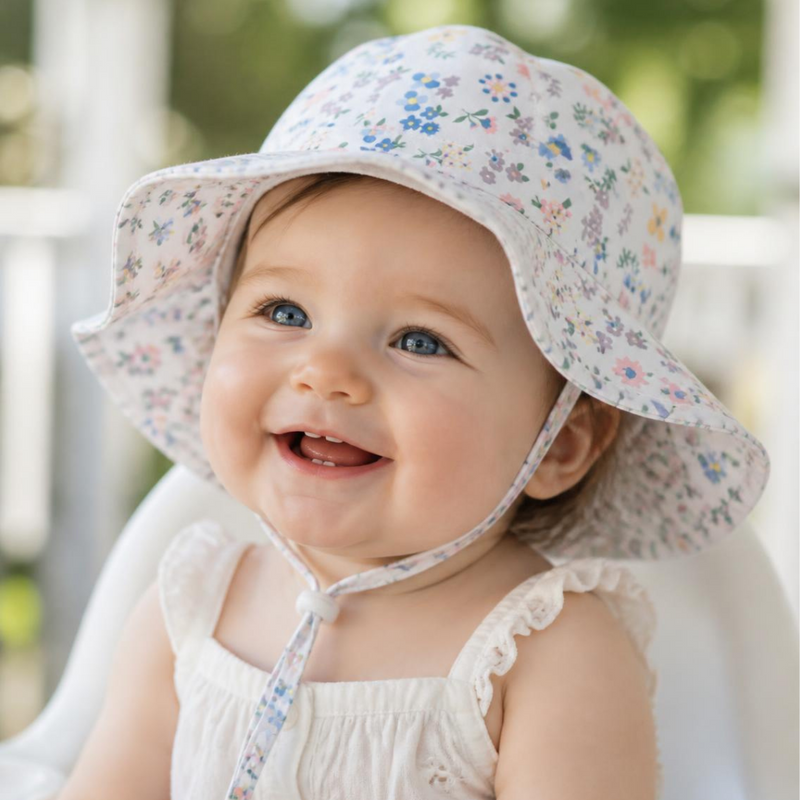

The right headband adds the sweetest finishing touch to a tiny outfit, while the wrong one leaves red marks and worry. Here is how to size to your baby's head, choose the gentlest fabrics, follow the safety rules that matter, and style bows for photos and everyday wear.
Australian owned, shipped from Melbourne.
Quick answer
Are baby headbands safe? Yes, when they are soft, correctly sized, and worn under supervision. Choose a band sized to your baby's head circumference, made from a breathable 4-way-stretch fabric, with no glued-on parts or rigid plastic. Always remove headbands before sleep, as Red Nose advises for every head covering, and in the car seat.
Step 1 · Fit
How to Size a Baby Headband
Size by head circumference, not age. A baby's head grows from roughly 33 cm at birth to about 46 cm by their first birthday, with the fastest growth in the first three months, so age brackets routinely fit too tight or too loose.
How to measure: Wrap a soft tape (or a piece of string laid against a ruler) around the widest part of the head, just above the eyebrows and ears. Do not pull it tight.
| Age | Head circumference | Suggested band (relaxed) |
|---|---|---|
| Preemie | 25-30 cm | 20-23 cm |
| Newborn (0-3M) | 33-38 cm | 30-33 cm |
| Infant (3-6M) | 38-43 cm | 35-38 cm |
| Baby (6-12M) | 41-48 cm | 40-43 cm |
| Toddler (1-3Y) | 46-50 cm | 43-46 cm |
A well-fitted band sits 1-2 cm smaller than the head so it stays put without squeezing.
The 2-finger rule: Slide two fingers under the band. Easy but with gentle resistance is a perfect fit. If you cannot fit two fingers, it is too tight. If it slides with no resistance, it is too loose and could slip over the eyes.
Step 2 · Fabric
Choosing the Right Fabric
Newborn skin is far thinner than adult skin, so a soft, gentle stretch matters more than looks. Here is how the main materials compare.
| Material | How it feels | Best for |
|---|---|---|
| Soft nylon Newborn favourite | Ultra stretchy, very light, smooth on fine hair | Newborns, photos, all-day wear; stretches newborn to toddler |
| Cotton knot or textured bow | Soft, breathable, a little more structure | Warm days and everyday outfits |
| Cable knit | Chunkier and warmer, holds a big bow | Cooler months and photos |
| Stiff elastic or hard plastic band | Grips hard in one thin line | Skip it for babies |
The take: The band does more of the work than the fibre. A wide, soft band spreads pressure across the head; a thin, stiff elastic is what leaves the dreaded forehead dent. Soft nylon is our go-to for newborns, and cotton and knit bows come into their own as bub grows. Sizing help is in our headband size chart.
Step 3 · Safety
Newborn Headband Safety
The rules that matter most, kept simple.
Supervision only
Headbands are accessories, not sleepwear. Remove before naps, bedtime, and the car seat, where a slipped band becomes a suffocation risk.
No glued-on parts
Choose bows that are sewn or embroidered, not glued. Glued embellishments can peel off and become a choking hazard.
No rigid plastic or wire
Avoid stiff plastic, wire, and harsh chemical dyes pressed against delicate newborn skin.
Check for loose threads
Inspect inside the band after washing to avoid hair-tourniquet risk on tiny fingers.
Watch for red flags
A mark that does not fade within about five minutes, or fussiness with a band on, means size up or take it off.
Step 4 · Style
Styling Bows & Headbands
Coordinate tone and texture, not exact patterns. Muted, earthy shades flatter newborn skin and photograph beautifully in natural light.
Photoshoot & announcement. Match a topknot or bow to a complementary swaddle in a muted, neutral palette: sage, oat, blush, terracotta, mocha.
Everyday wear. An oversized soft topknot adds fullness over sparse newborn hair, with no clips to fuss over.
Texture mixing. A soft ribbed band against a linen or knit outfit adds quiet depth that photographs beautifully in natural light.
Styles at a glance. Not sure where to start? A multipack is the cheapest way to find out which styles your baby tolerates.
| Style | What it is | Best for | Shop |
|---|---|---|---|
| Bowie double bow | One big, double-knotted cable knit bow | Everyday wear and photos | Headbands & Bows |
| Bowie single bow | The neater, smaller cable knit bow | Fine hair and everyday outfits | Headbands & Bows |
| Tinka tiny bows | Tiny bows on whisper-fine bands, in 5 packs | Newborns, christenings and gifts | Tiny Bows |
| Turbans | More coverage with a little retro charm | Bold looks and cooler mornings | Turbans & Hats |
| Flower headbands | Fabric and knit blooms on soft bands | Christenings, birthdays and spring photos | Flower Headbands |
| Hair clips | Small clips for when the hair finally arrives | Keeping fringes out of lunch | Hair Clips |
Keep reading: Are baby headbands safe? · Headband size chart · Find your shade
Why Sommerfugl Kids
Headwear, smocks, bows and accessories from an Australian owned shop, shipped from Melbourne. Gentle bands, sewn-not-glued finishes, and dozens of named shades to match every outfit.
Shop Headbands & Bows Explore Baby SmocksFrequently Asked Questions
Are baby headbands safe for newborns?
Yes, when they are soft, correctly sized, and worn under supervision. Use breathable, stretchy fabric with no glued-on parts or rigid plastic, and always remove the headband before sleep and in the car seat.
What size headband does a newborn need?
Size by head circumference, not age. A typical newborn (0-3 months) has a head of about 33-38 cm and suits a relaxed band of roughly 30-33 cm, about 1-2 cm smaller than the head so it stays secure without squeezing.
Which fabric is best for a baby's sensitive skin?
A soft, stretchy band matters more than the fibre. Soft nylon is very light and stretchy, which makes it a favourite for newborns and fine hair. Cotton knots breathe well on hot days, and cable knit suits cooler months. Avoid thin, stiff elastic and hard plastic bands, which press in one line and leave marks.
Can a baby sleep in a headband or bow?
No. Red Nose recommends no head coverings, headbands included, for any sleep. Never leave a headband on a sleeping or unsupervised baby, including in a car seat. Put it on for the moment, then take it off.
How do I know if a headband is too tight?
Use the two-finger test. You should be able to slide two fingers under the band with light resistance. Any red mark that does not fade within about five minutes means it is too tight, so size up.
How do I wash baby headbands?
Hand wash gently in cold water and lay flat to dry. Skip high-heat drying, which breaks down the stretch fibres that keep the fit soft and safe.